The file on
Trojan War
Legendary siege of Troy, traditionally dated c. 1200 BC
Was the Trojan War real? For nearly three thousand years it has shaped how people think about courage, pride, grief and the cost of war, and it gave us the phrases "Trojan horse" and "Achilles' heel." In this hour-long episode of The Wars Of History Podcast, Mike tells the complete story of the Trojan War, the legend and the history, in a relaxed, personal deep dive that keeps a clear line between what the poets sang and what archaeologists have actually dug up.
We begin with the sources: Homer, the Iliad and the Odyssey, the lost Epic Cycle, the Athenian playwrights and Virgil's Aeneid, plus Milman Parry's discovery of how oral poets composed epic poetry from memory.
Then the legend's beginning: the wedding of Peleus and Thetis, Eris and the golden apple, the Judgement of Paris, Helen of Sparta and the Oath of Tyndareus, and the sacred host-and-guest bond of xenia that Paris broke. We look at the version where Helen never reached Troy at all, and Marlowe's "face that launched a thousand ships."
Next, the gathering of the Greeks: Agamemnon of Mycenae, Menelaus, Odysseus faking madness, Achilles hidden on Skyros, the fleet stuck at Aulis and Iphigenia (told gently), the Catalogue of Ships, Protesilaus, Philoctetes and nine years of siege.
The heart of the episode is the Iliad: the anger of Achilles, the quarrel over Briseis, Helen on the walls of Troy, the duel of Paris and Menelaus, Glaucus and Diomedes trading armor, Hector's farewell to Andromache and their son, the embassy to Achilles and his choice between a long life and eternal fame, Patroclus in borrowed armor, the Shield of Achilles, the duel of Achilles and Hector, and King Priam's night journey to Achilles' tent, one of the greatest scenes in world literature.
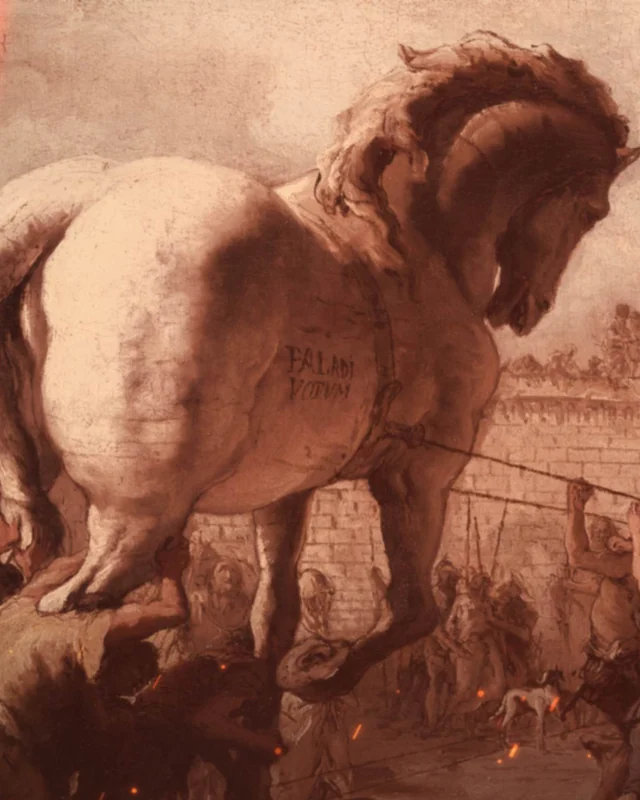
After that comes the fall of Troy: Penthesilea and Memnon, the death of Achilles and the origin of the Achilles' heel, Epeius and the Trojan Horse, Sinon, Laocoon's warning, Cassandra, Euripides' The Trojan Women, Odysseus meeting Achilles among the dead, and Aeneas carrying his father out of the burning city.
Then we step into archaeology: Frank Calvert, Heinrich Schliemann and the so-called Treasure of Priam, the nine cities of Troy, Dorpfeld, Carl Blegen and Manfred Korfmann, Troy Six and Troy Seven A, the Hittite archives, Wilusa, Alaksandu, the Ahhiyawa, the Luwian seal and the Late Bronze Age collapse. We finish with seven lessons from the Trojan War about pride, small choices, seeing your enemy as human, who really pays for war, trust and trickery, how stories change, and why legend and history both matter.